
Hypnosis consultations to overcome Fears and Phobias
You know perfectly well that your fear is irrational, and it changes nothing: faced with the plane, the ring road, the metro carriage or the dentist's chair, the body sets off the full alarm. That is what a phobia is: a reflex learned by the brain, which cannot be reasoned away but can be unlearned.
Our hypnotherapists see clients in Paris, Brunoy, Strasbourg, Saverne, Voiron, Montpellier, Saint-Gilles, or by video anywhere in France, gently, in imagination, and never by forcing a confrontation.

Video transcript
We are often asked to help with major fears or phobias. Fear is a normal and useful reaction to a perceived danger. But sometimes the fear grows in importance without any rationale and becomes disabling. A compelling desire to avoid the object of fear, followed by such a relief, comforts the person into believing that absolute avoidance is the best choice. Simple phobias include animals (spider, bird…), situations (fear of flying, dentist…), environment (height, deep water…), the body (fear of medical procedures, of needles…), and so many more. Complex phobias are related to social fears (fear of crowds, of leaving home…) Sometimes there has been a triggering event in your life. For example, a child is being scared by a tiny spider and the loving dad laughs and says “be careful, this spider will eat you up!” Such an innocent comment will trigger arachnophobia, the phobia of spiders Or, to keep the example of the spider, while a child is living through a traumatic event, say the loss of a parent, that child will develop a deep fear of spiders allowing him to feel scarred for a reason not as painful, the phobia becoming a support.
In this case, a psychologist or psychotherapist will be able to help. We will speak together at length to understand your situation as precisely as possible. For example, the fear of flying hides many other fears such as the fera of dying, loss of control, or simple claustrophobia. Knowing that will allow us to precisely choose the words and suggestions. Under hypnosis, especially with visualization techniques, you will gradually desensitize certain situations and reduce the fear to something that you can live with every day. You might never really like being in an elevator, but you will be able to do it when you must. So if you have disabling fears and would like to try therapeutic hypnosis, the team of hypnotherapists at Solutions Hypnose is here to help you. In person at our office or by video, both are equally efficient Make an appointment now to create your best life! See you soon.
Hypnotherapy is a complementary form of support and does not replace medical advice, diagnosis, or treatment. If you have any concerns about your health, please consult a physician first.

Building your calm: the three-stage method
Our work does not start with the fear: it starts with calm.
- First stage: installing and anchoring calm. A state of deep physical and mental calm, then anchored so that it is available at will, including on the day the anxiety rises.
- Second stage: taming it in visualisation. From very far away at first, or as a spectator (in a dissociated way), then step by step. The brain lives "situation + calm" instead of "situation + panic", and the old equation gets rewritten without you ever having to face your fear for real during the sessions.
- Third stage: preparing the real encounter. Mental rehearsal of the flight or the journey, and pocket self-hypnosis tools for the day itself.
To understand in detail how the brain builds a phobia (experience, transmission, avoidance) and why the mechanism can be reversed, read our full guide to fears and phobias.
The phobias we see most often in France
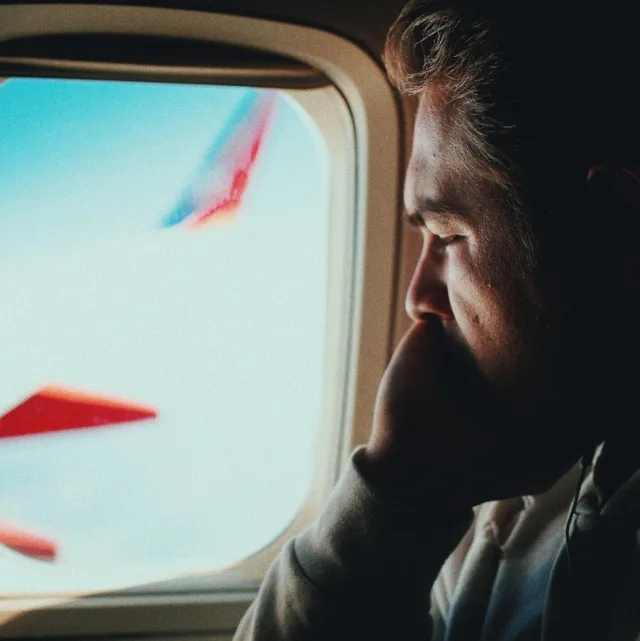
Fear of flying. Holidays turned down, work opportunities declined: aviophobia is expensive in life terms. Ideally the work starts a few weeks before a planned flight, and the flight then becomes the consolidation session.
Fear of driving. The great French classic: a licence passed, then years without driving, or an accident, and now the motorway is impossible, the ring road is a nightmare, and journeys get organised around avoidance. Getting back behind the wheel means getting back your independence, and it prepares very well in hypnosis, right up to the first real journeys.
- Fear of public transport. The metro, the RER, trains, lifts: the fear of being shut in, stuck, of fainting in front of everyone. When every commute is an ordeal, the whole of life shrinks. Hypnotic work first makes the journeys crossable, then neutral.
- Emetophobia (fear of vomiting). Little known to the general public, very present in our practices: foods avoided, restaurants declined, pregnancy dreaded, vigilance at every moment. It responds well to hypnotic work, which defuses precisely that hypervigilance.
- The dentist, needles, animals, heights… Every specific phobia is tamed with the same logic. And for fear of blood and needles, do mention any tendency to faint: the protocol adapts.
- Children's fears (the dark, animals, storms) are worked on in the form of stories and games, from the age of 4 or 5 (see Hypnosis for Children). And when the fear is social, other people's eyes or speaking up, the work also goes through self-confidence and performance anxiety.
When to see a psychologist or a psychiatrist first
Some situations are first a matter for psychological or medical care, and we will tell you so at the first meeting: a phobia born of a significant trauma (an assault, a serious accident), a panic disorder with agoraphobia that keeps someone housebound, invasive obsessions and rituals, or marked distress. Psychological trauma and severe anxiety disorders are treated, with validated approaches (including CBT). Hypnosis then comes alongside, with the agreement of the professional following you, never in their place.
What our clients say

« I'm still speechless at the results of my session with Annie. After just one session for my spider phobia, I'm seeing incredible results! I was skeptical at first, but it really works. The feeling of release is indescribable. I recommend Annie 1000%! Thank you again for this incredible change in my life. If you only knew the weight of anxiety you lifted off me! 🙏✨ »
Jessica, client of Annie Mayrand
« Christian is excellent and very professional, he responded to my call very quickly, and positive results came in a very short time (my fear of flying had settled in and made travel very hard). Right after our sessions I already took two 9-hour flights, and I'm amazed by the improvement — it went really well and I was even able to enjoy the trip, have a meal, take photos, read, and play with my child. For other areas of my life, I'll call on Christian's services again for the quality of his work and the trust it built. »
Karima, client of Christian Rocher
« After living for about twenty years with agoraphobia that kept me from driving on highways without having a panic attack, I decided to take charge and see a hypnotherapist. After three sessions with Sandra, I can now drive long distances on the highway without any problems. A big thank you to Sandra! »
MC, client of Sandra Djina Ravalia
« I want to thank Patricia for her exceptional work and compassion. My daughter was going through a very difficult time after a toxic friendship that had isolated her and deeply affected her. She had developed intense anxiety, including emetophobia, which was impacting her daily life. Thanks to Patricia's professional and fair support, things improved remarkably. In less than a year, my daughter found real peace of mind and a confidence she'd lost, and today she's able to assert herself, set her limits, and stand up to people who mean her harm. Thank you again! »
Christel, client of Patricia Jouannet
Ready to take back the ground your fear has taken from you?
In Office or Online Across France
Offices in Paris, Lille…
And if you live far away or elsewhere in the world, online sessions work very well. Evening slots available.

Frequently asked questions about hypnosis for fears and phobias
For a simple phobia (flying, driving, the dentist, an animal), most often two to five sessions: it is one of the areas where hypnosis works fastest. More complex or long-standing fears, or ones mixed with background anxiety, sometimes take more. And be wary of promises of a "guaranteed cure in one session": no honest practitioner can guarantee an outcome.
Not at all, and it is one of the most frequent and most rewarding pieces of work we do. Fear of driving without experience is an avoidance that has grown over the years, not an incapacity. The work tames driving in imagination, prepares reflexes of calm at the wheel, then supports the first real journeys, possibly alongside a few hours with an instructor.
No, never by force. All the work happens in visualisation, from a state of deep calm, at a distance and as a spectator at first. You will never go further than what you can comfortably cross, and you stay in control from beginning to end.
CBT is the validated reference, with graded exposure to the real situation. Hypnosis carries out a comparable desensitisation but in imagination and in a state of calm, which many people find gentler. The two are compatible and sometimes combined. For a trauma or a severe disorder, psychological care comes first.
You are very far from being the only one: emetophobia is one of the most frequent phobias in our practices, simply one of the least admitted. Its mechanics, permanent hypervigilance and food and social avoidance, respond well to hypnotic work. And being able to talk about it at last without feeling ridiculous is already part of the relief.
Not by France's public health insurance. Many private insurers do reimburse several sessions a year through their complementary-therapies allowance: check your policy before the first session, and we provide an invoice.
Going further
- Performance anxiety: when the pressure concentrates on one moment to get right.
- Hypnosis for Children: night fears, fear of the dark, fear of animals.
Hypnotherapy is complementary support and does not replace medical or psychological advice, diagnosis or treatment. In case of trauma or a severe anxiety disorder, see a psychologist or a doctor.

Page written by Sanae Belgarch
hypnotherapist and NLP coach
partner at Solutions Hypnose.
Updated .